

How Airfield Deicing Equipment Supports Consistent Application
Updated: 3 days ago
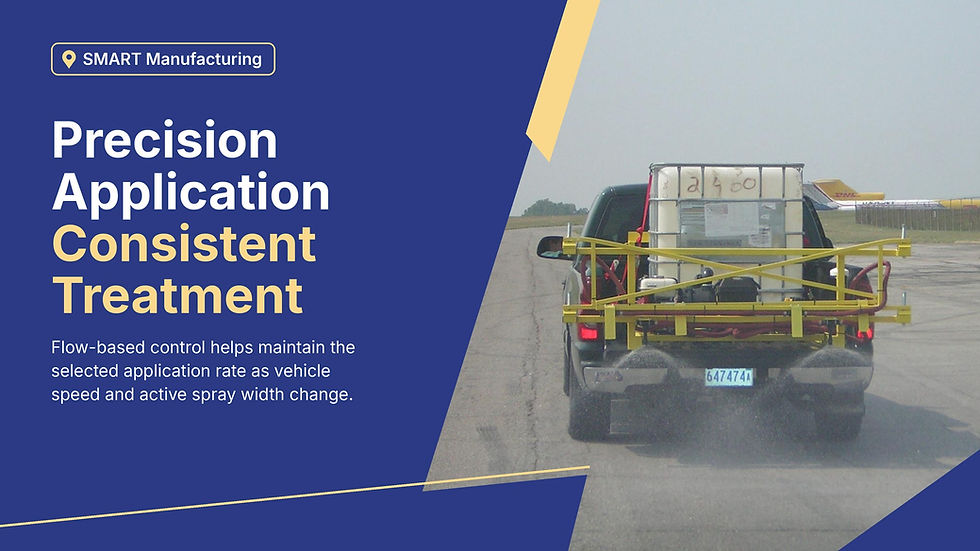
During an active winter event, applying more product is not necessarily the answer. What matters is how consistently and effectively it reaches the pavement as conditions change. Airfield deicing equipment can help crews maintain the selected application rate as vehicle speed and active spray width change, while operators select application rates based on current conditions and airport procedures.
For airport operations and maintenance teams, application is part of a much larger balancing act. Crews must respond to changing runway conditions, coordinate equipment and staffing, and manage product usage while keeping safety at the centre of every decision.
Precision application technology supports that work by helping crews control product distribution and maintain consistent treatment. The goal is not simply to use less material. It is to avoid unnecessary excess without compromising performance.
Winter Conditions Change Quickly
Conditions rarely stay the same throughout a shift. Precipitation rates, temperatures, and pavement moisture can change, while freeze-thaw transitions and varying runway contamination levels add to the challenge. Crews working overnight must manage those changes throughout their deployments.
As conditions evolve, inconsistent application can lead to uneven treatment coverage and unnecessary material usage. That variability affects both product management and the efficiency of the response.
Precision application technology helps crews control how product is delivered. Consistency does not mean treating every situation the same way: selecting an appropriate application rate remains an operational decision based on conditions and the airport's winter maintenance procedures.
How Precision Application Technology Works
The connection between vehicle movement and product delivery is central to controlled application. On the SMART Manufacturing SMART-Tote 125, the computer system monitors product flow, active boom width, and ground speed, then adjusts pump output to maintain the selected application rate.
Its application features include:
Flow-based control: Pump output adjusts as vehicle speed or active boom width changes.
Variable Orifice (VO) nozzles: Nozzle flow changes with vehicle speed and product flow.
Anti-drip design: The nozzles close when the vehicle stops.
These features address specific sources of application variability. They help control delivery of the selected rate; they do not replace the crew's judgement about what treatment changing pavement and weather conditions require.
What to Look for in Airfield Deicing Equipment
Winter operations depend on equipment that supports the people using it. Long shifts, rotating operators, seasonal staffing, and rapid deployment can all make it harder to maintain a consistent application process.
Controlled application rates and straightforward operator workflows help reduce that variability. For crews working under pressure, the value is practical: a process they can carry out confidently and repeatably, even as operators and priorities change.
That consistency matters beyond any individual pass. It helps teams maintain dependable performance across shifts and throughout an extended event.
Reducing Waste Without Compromising Treatment
Unnecessary product usage affects more than the material budget. It also influences product logistics, material handling, and deployment planning. During a prolonged event, those demands become part of the broader effort to keep winter operations moving efficiently.
More controlled distribution can help teams avoid unnecessary excess. But reducing waste should never be confused with under-applying product. Effective treatment remains the priority, and actual material savings depend on the equipment, operating conditions, and application practices.
The aim is to manage material use more deliberately, rather than relying on additional volume as a substitute for consistent application.
Simpler Workflows Help Crews Manage Complexity
During an active winter event, crews are already monitoring runway conditions, coordinating equipment, communicating with other teams, and responding to changing weather. Application systems need to support that workload, not add unnecessary complexity to it.
Straightforward workflows can reduce operator burden and make consistent performance easier to maintain. A system's value depends not only on its capabilities, but on how confidently crews can use those capabilities in real-world conditions.
That becomes especially important over repeated treatment cycles and overnight shifts. A single successful deployment does not tell the whole story; equipment needs to support crews throughout the event.
What to Consider When Evaluating Precision Application Technology
For airport operations and maintenance teams, the most useful evaluation connects equipment capabilities to everyday winter maintenance needs. A few practical questions can guide that discussion:
Can operators maintain consistent application while responding to changing conditions?
Can the system reduce unnecessary product usage without compromising treatment performance?
Does it simplify workflows for crews working across shifts and extended events?
These questions keep the focus on how the system will be used, rather than product volume alone. Application accuracy, repeatable performance, and ease of operation all contribute to a more consistent winter maintenance response.
Looking to Improve Application Consistency During Winter Operations?
Whether your priority is reducing product waste, simplifying operator workflows, or maintaining consistent treatment during extended events, precision application technology can support your winter maintenance program.
Team Eagle offers SMART Manufacturing anti-icing and de-icing equipment for airfield applications. Features such as the SMART-Tote 125's computer-controlled application system and Variable Orifice nozzles provide practical ways to control product delivery as vehicle speed and spray width change.
The right equipment choice depends on your airport's application requirements and workflows. Discussing those needs with the Team Eagle team can help connect the available features to how your crews actually operate.
The focus is straightforward: helping crews apply the right amount of product at the right time, with confidence and consistency.


Comments